2012 is a 2009 American science fiction disaster film directed and co-written by Roland Emmerich. It stars John Cusack, Chiwetel Ejiofor, Amanda Peet, Oliver Platt, Thandie Newton, Danny Glover, and Woody Harrelson, among others. The special effects are so real that one will not even notice the two hour forty minute period that they have spend watching the movie.
Every sequence in the movie begins as a storyboard, or a rough, comic book-like version of the film's action. This particular sequence, which depicts Curtis Jackson (John Cusack) rescuing his family and driving them to the Santa Monica airport.
After the storyboards are done, the artists move to a stage called the pre-visualization. "I describe it as an early form of a CG version of a sequence, with video-game quality [visuals]. A crude version of the action, pre-visualization includes every part of the scene, up to camera angles and early sound effects
Director Roland Emmerich shoots the limo against a massive blue screen in Vancouver, Canada. The shot, called a live action plate, looks like this before any virtual elements are added.
James Earl Jones. The loins tremble just speaking the name. If Arnold Schwarzeneggers muscles could talk, they would sound like James Earl Jones' voice. To anyone unfamiliar with Mr. Earl Jones' work (because they've been in a coma and woke up to find the world had changed -hint: next blog post possibly?), perhaps an example or two will tickle your pickle. Mr. Earl Jones was the voice of Darth Vader in Star Wars Episode IV: A New Hope (aka the greatest film saga in history) and also voiced Mufasa in The Lion King. He also reprised his role as Darth Vader in Episode III: Revenge of the Sith. When such a talented actor played the father of Eddie Murphy (Delirious, Raw, Beverly Hills Cop, Norbit, Coming To America), Coming To America became an instant comedy classic.
In Coming To America, Eddie Murphy plays Prince Akeem, the son of the King to the land of Zamunda. Having lived a pampered life for twenty one years and being told to marry a woman who would obey his every command but have no opinion of her own, Akeem sets out to discover a woman who will "arouse my intellect as well as my loins". Having decided that the most fitting place to find a woman fit for a king would be Queens, New York, Akeem meets a myriad of Americans with his best friend Semi, all of whom, surprise surprise, are played by Akeem and Semi themselves!
Eddie Murphy and Arsenio Hall underwent hours and hours of make up to portray multiple characters throughout various scenes in the movie. In one scene, Akeem and Semi walk into a barber shop where they are greeted by three barbers, two of which are played by Eddie and Arsenio, as well as another character in the barber shop also played by Eddie.
Perhaps Eddie's greatest character in the movie, he plays an old, white Jewish man in the barber shop, alongside one of the barbers.
When asked to play the role of the old, white man, Eddie merely pointed to his face. This is where Rick Baker was brought in. Master make up artist Rick Baker, who has won numerous awards for his make up talents, did the make up for the movie with "close to no money". The barber shop scene had to be shot from certain angles and done with voice overs to hide the fact that Eddie and Arsenio were playing pretty much all the characters. Shit's crazy.
Eddie(right) and Arsenio(left) with their barber makeup on
Well if you put together actors like Emma Stone and Jesse Eisenberg in one gory Zombie film, there's bound to be some laughs!
Right?
Zombieland directed by Ruben Fleischer and written by Rhett Reese and Paul Wernick was released in 2009 delivering a Zombie Comedy film about survivors of the zombie apocalypse road tripping around Southern states of America to find an ultimate sanctuary free from Zombies. Throughout the film the main character, Columbus, played by Jesse Eisenberg lists a set of guidelines on how to survive the 'Zombieland'. These rules present themselves as both ironic and straight-up hilarious!
What makes this film successful is, of course, its ability to create 'believable' Zombie characters with 'abit' of make-up and visual effects that give the audience a hit of fear along with some witty dialogue.
Here's Amber Heard getting Zombiefied for the film!
The director wanted to ground the film into reality by doing extensive research on real life plagues and diseases to create a viral plague of zombie characters. The application of prosthetics take about 1 to 1.5 hours. And then the real fun starts, taking up another hour creating vains, blood, tooth stains, contacts lenses and jaw-droppin' guts all over the body!
I'm sure everyone in the entire world has heard of Peter Jackson. Even if you don't remember his name, you would most definitely remember his films. For example, there was this pretty well known trilogy he did called Lord of the Rings,
definitely something you guys should check out.
So yeah Jackson has made some pretty epic movies not including the Lovely Bones. No, I am 100% serious about this, I know you may think "But it's Peter Jackson, he made LOTR! Surely anything he makes is awesome and even if it's relatively sub par we can forgive it because he's given us one of the greatest movie trilogies of all time.Not to mention his great contribution to the dramatic society of the word, with the dichotomous monologue between Smeagol and Gollum which epitomised the internal struggle faced by an individual(s). NO. This film is unforgivable, regardless of the fact that it has Mark Wahlberg
and several other really well known and respected actors in it. The other one I can think of is Stanley Tucci you know, the gay guy from The Devil Wears Prada and Puck from A Midsummer Nights Dream? No? Okay.
So now that we've established Peter Jackson's most successful and most horrifically disappointing films, I'd now like to continue onto the other film he did (what?) Yeah, I know right.
Well a few years ago, Jackson attempted to remake one of the most classic films of all time, King Kong. This was an iconic film, originally made in 1933, which was very well received for it's pioneering in special effects such as stop motion animation.
Nailed it.
But that's not what I'm here to talk about. In 2005, Peter Jackson remade this film, with a whopping $207 million dollar budget, into a 187 minute long nostalgia-drama which basically delved into old Hollywood romance, the flapper era, and a contest to see who could pay attention longest before falling asleep. Jackson spent probably 2 hours on character development to build the sexy sexual tension between Naomi Watts, and Adrien brody which I will never complain about.
Apart from wasting time and money, Jackson also had multiple specifications on how he envisioned King Kong to appear on screen in the final edition. Most of these surmised to him wanting King Kong to look like an ape not a human.. So how did he do this?
He watched hours and hours of Gorrilla footage in London Zoo to further his understanding and gain an anthropological upper hand in the creation of his Kong. He then decided that he was unsatisfied and travelled to Rwanda to observe wild gorillas in their native habitat.... Andy Serkis (Gollum/Smeagol) was the model that was used to track Kongs Movement, and this was done by filming all the movement Serkis made, by placing him in a body suit, and using the motion detectors as a guide to animate King Kong.
Film written and directed by the Wachowski Brothers
An introduction to "Bullet Time"
Remember this?
Bullet time, the visual effects used in the film was used to create a character's control over time and space. Scenes were filmed using cameras that allow them to film in slow much but show on screen what appears to be normal speed. Bullet time effects are often quite complex to film. Using 3D stimulation, they fired camera fractions of a second after each other. This captured every single action, (so about 12000 frames for a 3 second scene) to create the most iconic slow-motion effect.
Various cameras would circle around each other to shoot the scene. The Matrix hired George Borshukov who specialised in this field to edit out the cameras in the background using 3D models that were based on geometry of buildings and even photographs of buildings.
LIGHTS CAMERA ACTION!
The "bullet time" scenes like the ones shown above were The Matrix's most successful and mind-blowing scenes. Adding to a cyberpunk mystique film, the directors were able to bring out intense fight sequences that were remarkable and most of all, rememberable.
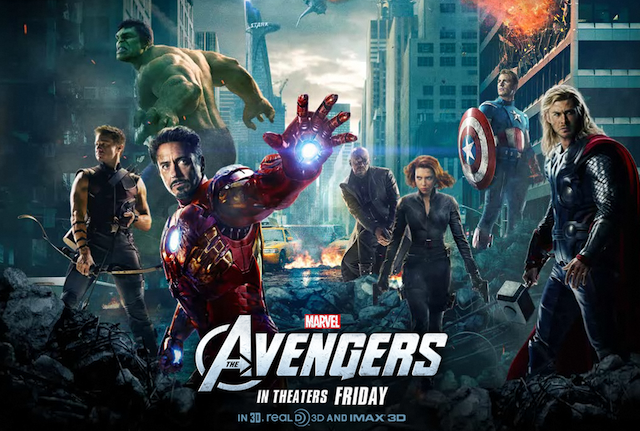
A film that required half a decade of solo prequels to build character ( in the case of Iron Man, literally), The Avengers was released last year to enormous box office success. A movie that combines all of Marvels greatest superheroes in the ultimate culmination of action and geekdom. As the previous movies have already introduced the characters, the film takes off with a running start and incorporates special effects throughout it's entirety very well.
Seeing as the film is based on comic book heroes with super powers brought to life on the big screen, a large company with computer animated experience was required to provide the special effects. Enter Industrial Light & Magic, a company with a grade A track record of special effects in some of the biggest blockbusters including Iron Man 1 and 2, Transformers 1, 2 and 3, Rango and Star Wars Episode 3: Revenge of the Sith to name a few.
Using various software tools alongside green screens and live action movement from the actors and actresses, Industrial Light & Magic created a special effects experience like no other that not only caused The Avengers to become one of the worlds highest grossing movies, beaten only by James Cameron's Avatar and Titanic, but also won the Academy Award for Best Special Effects.
One of the biggest challenges in The Avengers was animating The Hulk. A by product of a nuclear radiation gone wrong, The Hulk was perhaps the most difficult character to animate due to his size and nature.
Avatar as a film, was pivotal in the fact that it pioneered new technologies in the area of special effects in order to acheive the visual effects that were created in Pandora, and that of the Na'vi people. First of all, if we examine the pure aesthetics that the film contributed to cinema history, which on it's own would have heavily contributed to the films success purely due to the fact that audiences would no longer have to suffer through the inferior technologies of films like Godzilla.
Okay fine... So Godzilla was also immensely influential for it's time and back when it was made the special effects used probably blew a few minds too. However I digress from my original point which is mainly in praise and examination of the awesome techniques which were pioneered by the man who gave us Jack and Rose and most importantly, that sketching scene (you know the one). So finally, I bring you the breath taking visuals seen in the world of Pandora.
should probably mention that in order to fully appreciate the truly righteous visuals in this film, you need to watch this video in the highest quality that is available (1080p), max your speakers and solemnly nod your head to the soothing tones of Leona Lewis.
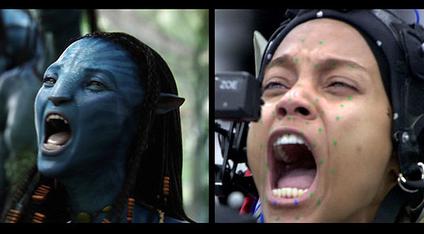
If you look at the actual N'avi people themselves were created visually through special cameras created by Cameron which were built into a six inch boom that allowed the actors facial expressions to be digtised which then made it possible for the animations to be edited in post production.
Other techniques that were used include the new light system that was created in order to light areas such as the jungle in Pandora. A motion capture stage or volume was used which was six times larger than any other known, it also enhanced the picture of the facial expressions of the actors. The main characters who were in the film had to wear skull caps fitted with tinycameras in order to be animated. These cameras were positioned in front of the actors faces, the signals detected by the cameras were then sent to computers where they were then animated
So I think, to wrap this all up, the most conclusive and accurate evaluation of James Camerons success is by looking at the unprecedented box office success of this film which was $2,782,275,172 which seems more like a locker combination than an actual probable figure of tangible money but hey, when you made something like Titanic, the other most successful film in box office history, why not make another film just to beat that record.
Unluckily for Cameron he lucked out in the best picture category, beaten by none other than Katheryn Bigelow, his babe of an ex wife. (Dun dun)